



Making offices work | Q&A with Craig Burrow
Following the launch of Town Centre Securities’ latest Leeds development, the 12-storey, 111,000 sq ft Z on its Whitehall Riverside site, Place Yorkshire met with the developer’s group property director to discuss industry challenges, office trends, and tech must-haves.
Q. When did TCS acquire Whitehall Riverside, what’s been delivered so far, and what timelines are in place for Z?
TCS has owned the site for many, many years and over time, has disposed of part of it to a developer for a residential development, then developed the first office building, No1 Whitehall Riverside, and more recently the Premier Inn Hotel. For a long time, the land between these developments was used as a surface car park.
I joined TCS in October 2020, and having worked in Leeds for my entire career I had often looked at Whitehall Riverside and was keen to bring forward further development. On joining, I revisited the old master plan and refreshed it. Given the direction of the residential sector, I wanted us to explore a more mixed-use masterplan.
In January 2022 we announced a deal with Glenbrook, who are now delivering a 500 apartment residential BTR development, forward funded by Legal & General, due to complete in January. As part of that new master plan, we secured detailed consent for the office building [Z], and a multi-storey car park, alongside outline consent for two further plots – one of which could be an office, hotel, or aparthotel.
We’ve been working on Z for around four years, gaining planning consent in March last year. The decision on whether to bring forward the office or the MSCP first is still under review, as the two are closely linked. The car park supports both the office and the wider development, as well as providing city parking, so phasing requires careful consideration.
At present, delivery depends on market conditions. We need pre-let commitments before securing funding, and funding before construction. We’ve been working with GMI Construction for a couple of years, so we’re at a point where, with the right commitments, we can move quickly. We’re in meaningful discussions with potential pre-lets.
Q. Do you have more concrete figures for how much it will cost?
We have an updated cost plan based on RIBA stage 4 design, which has been market tested with some of the main packages. However, this isn’t a fixed price as yet as we don’t have a fixed timescale. Build costs, yields and interest rates are all significantly higher than five years ago.
The only way of making a new office building viable today is for rents to have risen in line with those costs. I was reviewing a market commentary from Manchester recently, comparing headline rents from two years ago to now, and the difference is striking.
I wouldn’t want to quote exact numbers in terms of what it’s going to cost us to build, but I think as a guide, any new office building is going to be in the order of circa £300/sq ft on the gross. With occupiers now expecting significant amenity space – multipurpose rooms, lounges, gyms, wellness facilities, coffee areas- traditional net-to-gross targets are no longer realistic. Developers must sacrifice some lettable space to deliver those features.
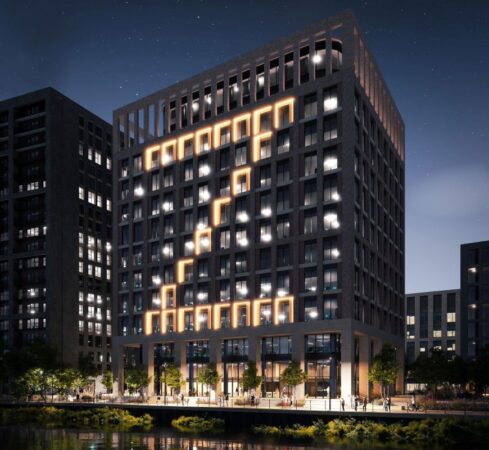
Z was designed by Enjoy Design with landscaping by Re:Form, while BNP Paribas and Sanderson Weatherall have been appointed as letting agents on the scheme. Credit: via Space PR
Q. So, the trend away from traditional offices into higher grade, more flexible working spaces has affected viability?
I’m generalising, but I think what we’re seeing is a lot of businesses trying to understand what their spatial requirements are. I don’t think many have managed to get to the point of knowing exactly how much space they need for the next three, five, 10 years. Historically, occupiers would sign 15-year leases; today, predicting even a few months ahead is difficult.
As a result, occupiers increasingly like the idea of a building that has some flex space within it, whether that is to allow them to expand, have some project space or whatever their specific requirement may be. It’s not a new thing that occupiers have been looking at committing longer-term to a core of space and then having flexibility on additional space. I think the rise in flexible workspace providers over recent years demonstrates that this is a big part of the market now, which was something we were very keen to build into the base design for Z.
We have an occupier that we are in fairly advanced negotiations with to take three floors within the building for that flex provision. It’s not a legal commitment yet, but it aligns with our vision for the building. In essence, it’s like a partial pre-let, though we’ll need further commitments before funding is secured.
Q. In terms of the whole Whitehall Riverside site, what have been the biggest challenges and opportunities that have come up so far?
In terms of the challenges, I think most developers over recent years will have experienced the challenges of high inflation, interest rates, market sentiment, build cost, contracts, availability, certainty on contractors, supply chain, regulation changes… It’s been a fairly difficult period to navigate. I think it continues to be a difficult period to navigate. The funding market isn’t necessarily where it needs to be, in my opinion, and for that reason, bringing anything through the planning process has been difficult.
The opportunity lies in location. Whitehall Riverside now sits at the centre of major development activity across Whitehall Road, Globe Street, and Water Lane. That vibrancy adds huge value to our scheme.
Q. Are there any other trends affecting how you design an office building?
Future-proofing is a major consideration. Sustainability is now far broader than just BREEAM or EPC ratings; multiple credentials are required to remain competitive. Smart buildings are also central – how technology connects, collects, and uses data to reduce energy consumption and improve user experience.
Designing with occupiers in mind is key. Ultimately, they determine which smart features are ‘must-haves’ versus ‘nice-to-haves’. Heating, cooling, lighting, and access control remain the fundamentals, but flexibility in systems is essential. There’s a lot to think about when you’re trying to design something, hoping that it’s going to be the right thing for the right audience.
Q. How do you go about choosing which smart tech you want in your development? How do you cut the wheat from the chaff?
It’s a good question. We start with ‘what’s possible?’ and you can go from the sublime to the ridiculous. For example, linking car park entry to an office coffee machine is possible, but adds little real value. Is it really worth going to that extent of functionality?
Instead, we focus on systems that can be connected, with the flexibility to adapt to occupiers’ needs. The real value lies in how data is collected, analysed and used to improve efficiency. Ultimately, occupiers will prioritise cost-effective features. I think, when you boil it down, the core fundamentals will still be around heating, cooling, lighting, and access control. They tend to be the things that people get quite emotional about.
Q. In terms of the trends around offices at the moment, Z incorporates the big three: flexible work, sustainability, and smart tech. Is there anything else that’s coming to the forefront that as a developer, that you can see being a big deal in the future?
Wellness and community are equally important. Our riverside location is a huge USP: it connects directly to the station, provides a riverside walk, and offers access to running and cycling routes away from main roads.
Encouraging people back into the workplace depends on creating environments with purpose—places where people want to spend time, not just work.
Q. And finally, if I gave you a magic wand and you could solve one problem facing the industry at the moment, what would you fix?
Just one? Narrowing it down, I’ve been saying for a long time that the the introduction of the gateway process through the Building Safety Act is a huge risk to the industry. How can you operate in an environment where you don’t know what your timescales are, because you are completely beholden to a process where there is some guidance around a timescale, but it’s not by no means a guarantee? Greater certainty in that process would have a huge positive impact.
If we could reduce interest rates, that would be another good one. The cost of borrowing is a big barrier at the moment. Viability is on everybody’s mind – how do you get these schemes to work? So that that’s another one that as an industry, I think we’re all sharing in that misery.